
A rain sensor should pause irrigation when enough rain has occurred, then allow the schedule to resume after its sensing material dries. A sensor that is bypassed, shaded, poorly wired, or set too high can allow unnecessary watering through a storm.
Test the sensor before relying on it during a wet period. Follow the controller and sensor manuals because wiring and reset behavior vary by model.
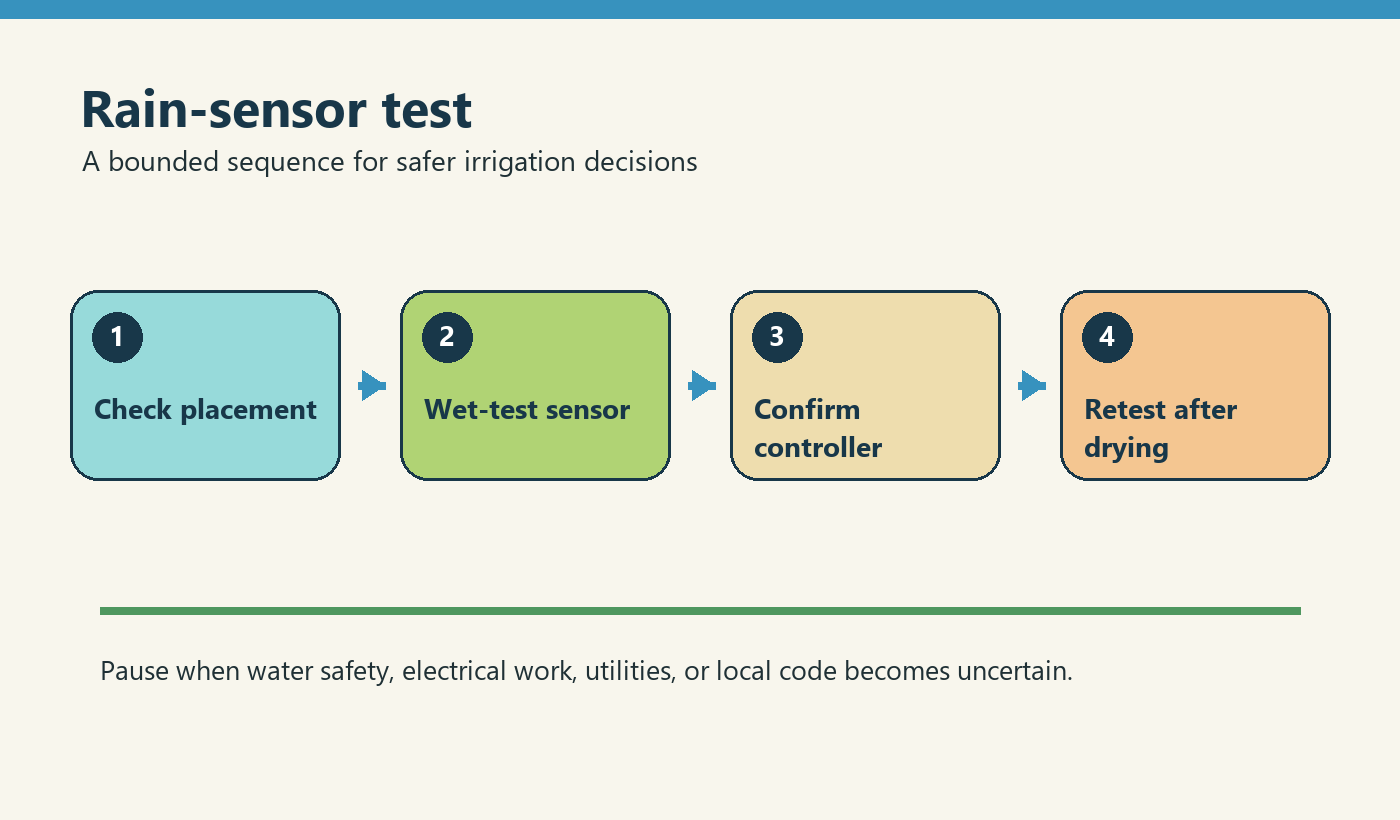
Check placement first
The sensor should receive normal rainfall without being sheltered by an eave, tree canopy, wall, or dense foliage. It should not sit where sprinkler overspray repeatedly wets it, unless the manufacturer allows that placement.
Mounting angle and height can affect drying. A sensor that never dries may keep irrigation off too long; one that dries too quickly may resume watering before the soil has benefited from rainfall.
Verify controller settings
Confirm that the controller’s sensor input is enabled and not set to bypass. Some controllers show a sensor icon or message when the circuit is active. Record the current seasonal adjustment and rain-delay setting separately; a rain sensor does not replace all schedule decisions.
| Test result | Likely next check |
|---|---|
| Zone runs while sensor is wet | Check bypass setting, wiring, and sensor compatibility. |
| Controller shows sensor active but zone still runs | Review controller program and manual override mode. |
| Sensor never activates | Inspect placement, wiring, and the sensor element. |
| Sensor stays active for days | Check drying exposure and sensitivity setting. |
Perform a controlled wet test
Start a manual zone with the controller nearby. Wet the sensor according to the manufacturer instructions, often by applying water evenly to the sensing discs or cup. Confirm that the controller interrupts or blocks the zone as expected.
Do not soak electrical connections or open the sensor enclosure while energized. If the test behavior is unclear, stop and consult the model documentation rather than changing wire terminals by trial and error.
Set sensitivity and retest
Adjust the sensor only in small steps. A low threshold pauses irrigation after a small amount of rain; a higher threshold waits for more rainfall. The appropriate setting depends on soil, slope, plant type, local restrictions, and the controller schedule.
After the sensor dries, run one zone and check whether the schedule resumes normally. Record the setting, test date, sensor location, and result.
Calibration checklist
- Confirm open exposure to normal rainfall.
- Verify sensor input is enabled and not bypassed.
- Wet-test the sensor using the manufacturer procedure.
- Adjust sensitivity gradually and retest after drying.
- Record placement, setting, and result for seasonal maintenance.
- Write the symptom and the affected zone or component before changing anything.
- Measure under normal operating conditions and compare representative locations.
- Make one controlled change and record the date, setting, or part used.
- Run a verification cycle and inspect both the source side and the far end.
- Pause for electrical, potable-water, utility, pressure, structural, or code uncertainty.
- U.S. EPA WaterSense: Watering Tips — practical guidance for efficient landscape watering.
- U.S. EPA WaterSense: WaterSense Labeled Controllers — context for weather-based and sensor-informed control.
- USDA NRCS: Irrigation Water Management — soil, water application, and management considerations.
- Penn State Extension: Drip Irrigation — drip-system layout, operation, and maintenance context.
- Irrigation Association: Backflow Prevention — general cross-connection and backflow-protection context.
What to verify for this topic
For this subject, begin with sensor placement, controller input, wet-test behavior, drying time, and bypass settings. Those details determine whether the next step is a schedule adjustment, a cleaning or repair task, a design change, or a request for qualified service. Do not infer a cause from one visual clue. Compare the affected area with a normal area, and compare the start of the run with the far end when water travels through a line.
The safe boundary is to verify that the sensor changes the actual watering decision instead of relying only on an app icon or controller message. If the system cannot be isolated, the measurement cannot be trusted, or the proposed action would change a regulated connection, leave the equipment in a safe state and document the condition for the person who will complete the work.
Work through the decision in a repeatable order
The most useful way to apply this guidance is to separate observation, measurement, adjustment, and verification. Start by writing down the current symptom and the part of the system affected. Then identify the water source, the zone or component involved, and any recent change such as a repair, new planting, weather event, fertilizer application, or controller reset. This prevents a familiar-looking symptom from being treated with the wrong fix.
Use one controlled change at a time. If you change a nozzle, runtime, pressure setting, filter, sensor threshold, or pipe route, record the change before testing again. When several variables are changed together, it becomes difficult to tell whether the improvement came from the repair or whether a new problem was introduced. A short written record is usually enough: date, zone, starting condition, measurement, change made, and result.
| Stage | What to record | What a useful result looks like |
|---|---|---|
| Observe | Location, timing, weather, recent work, and affected plants or equipment | The symptom can be reproduced or described precisely |
| Measure | Pressure, flow, moisture, runtime, output, or equipment status as relevant | The measurement is taken at a comparable point each time |
| Adjust | One repair, setting, cleaning step, or schedule change | The change addresses a plausible cause, not only the visible symptom |
| Verify | Near and far points, startup and shutdown, and the next normal cycle | Water reaches the intended root zone without unsafe behavior or waste |
Use the field check before buying parts
Before replacing equipment, inspect the simplest causes that fit the symptom. Confirm that the correct valve, filter, sensor, controller program, shutoff, or power source is being tested. Look for leaks, clogged outlets, damaged insulation, unusual pressure change, runoff, standing water, or a setting that was changed during earlier work. A replacement part cannot correct an undersized zone, a blocked filter, a bad route, or a schedule that does not match the site.
For a meaningful comparison, test under normal operating conditions. A pressure reading with every zone closed may not describe the pressure while the zone is running. A soil check at the surface may not describe the moisture at root depth. An app status may not prove that a valve opened. Repeat the check at representative near, middle, and far points whenever the system has a long run or different elevations.
Know when to pause
Stop the work when water can reach a drinking-water line, when an electrical enclosure or pump circuit is wet or energized, when excavation reaches an unknown utility or obstruction, when a pressurized component cannot be isolated, or when a repair would require bypassing a safety device. Also pause when the proposed change could create runoff toward a building, road, drain, well, or neighboring property. Keep the system in its safest known state and obtain qualified local guidance where code, licensing, testing, or equipment instructions apply.
Keep a small maintenance record
Save the model numbers, zone names, photos, measurements, settings, repair dates, and next review date. Note what did not work as well as what did. This record helps a future technician start with evidence, supports seasonal adjustments, and makes it easier to notice a gradual decline in flow or coverage. Recheck the system after major weather, landscaping, water-source, controller, or equipment changes.
Practical close-out checklist
References
These sources provide general water-efficiency, irrigation-management, controller, drip-irrigation, and backflow context. Local plumbing, electrical, water-use, excavation, and landscape rules can be stricter; manufacturer instructions and the applicable local authority control the final decision.