
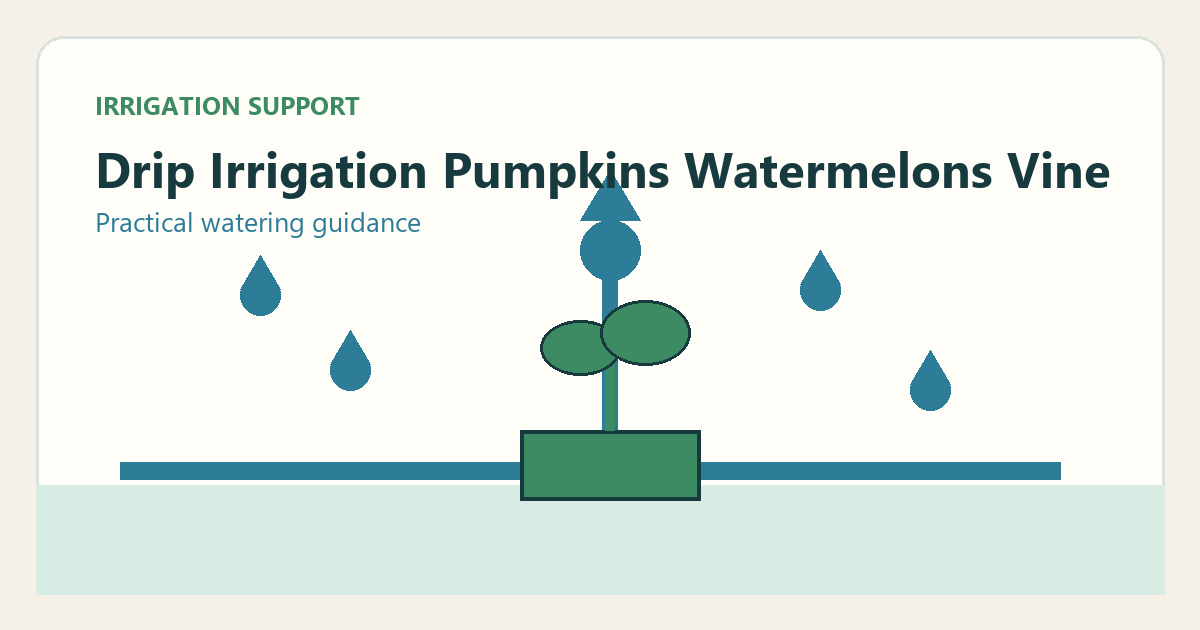
Pumpkins and watermelons are big, thirsty plants with deep root systems, and getting their irrigation right is the difference between prize-winning fruit and disappointing harvests. Drip irrigation reduces vine diseases like powdery mildew and downy mildew by 50-70% compared to overhead sprinklers.
What Drip System Works Best for Pumpkins and Watermelons?
5-1 GPH flow rate. Vine crops are planted on wide spacing—4-6 feet apart for pumpkins, 3-5 feet for watermelons—so each plant needs a larger wetted area. Lay one drip line per row, 4-6 inches from the base of the plants.
For hills with multiple plants, create a loop around each hill with 4-6 emitters. Operating pressure is 10-15 PSI for drip tape or 15-25 PSI for standard tubing. Use a compatible pressure regulator ($10-15). Drip irrigation complete guide.
How Much Water Do Pumpkins and Watermelons Need?
5-2 inches of water per week, with the most critical period being fruit set through harvest. A single pumpkin plant with a 4-foot canopy needs about 2-3 gallons of water per day during peak growth. For a 50-foot row with 5 pumpkin plants spaced 6 feet apart, that’s 10-15 gallons per day—about 70-105 gallons per week.
5-2 inches per week. Run the drip system for 45-60 minutes per session, 3-4 times per week. During fruit ripening, reduce watering slightly—too much water during ripening dilutes sugar content in both crops. For more on watering schedules, check the related irrigation design guide.
When Should You Water Pumpkins and Watermelons?
Early morning watering (5-8 AM) is best. It allows water to soak deep before the sun intensifies, and the foliage stays dry through the day—critical for preventing powdery mildew. Run drip cycles of 30-45 minutes, 3-4 times per week through vegetative growth.
Increase to 4-5 times per week during flowering and fruit set. Reduce to 2-3 times per week as fruit approaches maturity. Critical watering windows: at planting (keep soil consistently moist for 7-10 days for germination), at flowering (drought stress causes blossom drop), and during early fruit development (stress causes misshapen or aborted fruit). A soil moisture sensor ($20-40) takes the guesswork out. Irrigation timer programming 4 step guide for any controller for automated scheduling.
Should You Use Mulch with Drip for Vine Crops?
Yes—and Consider black plastic mulch for pumpkins and watermelons. 5 mil black plastic mulch. Cut X-shaped slits at planting locations.
Black plastic warms the soil 5-10°F earlier in spring, conserves moisture, suppresses weeds, and keeps fruit clean. The combination of drip irrigation plus plastic mulch can increase yields by 30-50% compared to bare soil with overhead watering. For organic setups, use 2-3 inches of straw or composted wood chips over the drip lines instead of plastic. For more on soil management, see the related sprinkler systems guide for alternative approaches.
How Much Does Drip Irrigation for Vine Crops Cost?
For a 50-foot row (5 pumpkin hills): $10-15 for 50 feet of drip tape or tubing, $10-15 for pressure regulator and filter, $10-15 for header tubing and connectors, and $15-25 for a timer. Total: $45-70. Add $15-20 for 50 feet of black plastic mulch if using.
For a 5-plant pumpkin patch, this compares to $0 for rain-only or hand watering, but the yield improvement of 30-50% easily pays for the system in one season. 40/ft) for 5+ year durability. For a full cost comparison, see irrigation system costs.