
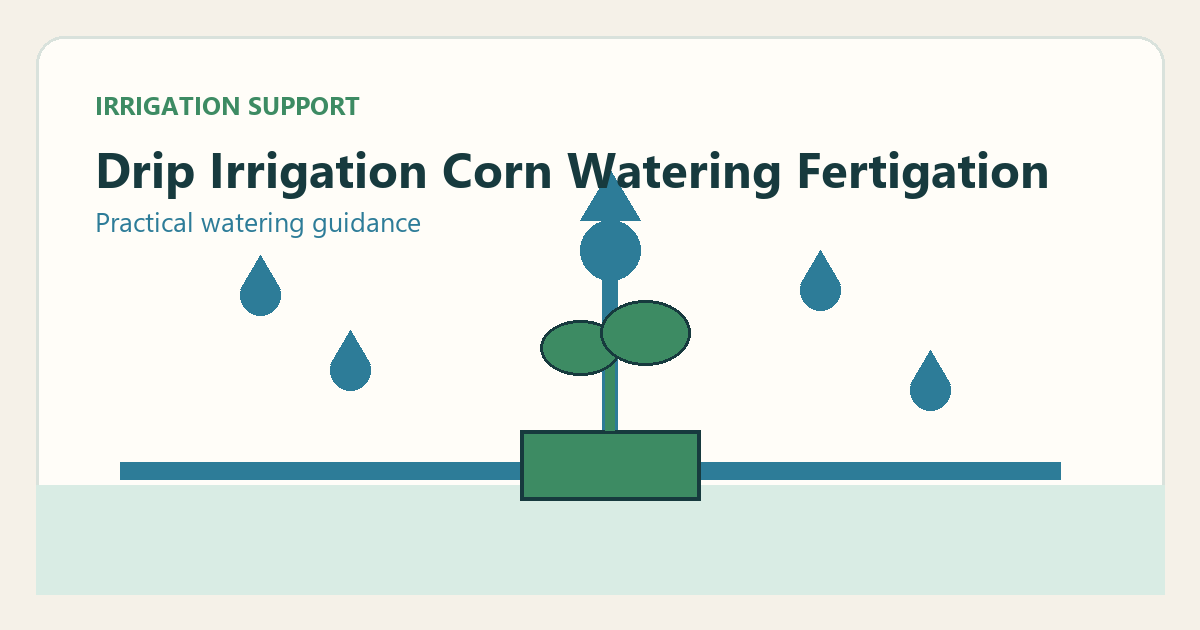
Drip delivers water straight to the root zone without wetting the stalks, which reduces lodging and fungal disease.
What Drip System Setup Works Best for Corn?
5 GPH flow rate per emitter. 15 per foot — making it ideal for row crops. Lay one drip line per corn row, placed 2-3 inches from the base of the plants and 1-2 inches deep if using subsurface.
For twin-row planting (two rows on one bed), use two drip lines spaced 12 inches apart. Standard operating pressure for drip tape is 8-12 PSI — lower than standard drip tubing’s 15-30 PSI. A compatible pressure regulator costs $10-15. Drip irrigation complete guide.
How Much Water Does Corn Need Through Drip Irrigation?
5-2 inches of water per week during the peak growing season (tasseling to ear fill). 5 GPH per emitter at 8-inch spacing, a 100-foot row receives about 75 gallons per hour. To deliver 2 inches per week over a 100-foot row (assuming 30-inch row spacing, roughly 250 sq ft), you need about 310 gallons per week.
5 hours per week, split into 2-3 watering sessions. 5-3 inches per week. Irrigation system cost and roi breakdown includes water usage calculations for different crops.
When Is the Best Time to Water Corn with Drip?
Early morning watering (5 AM to 8 AM) is ideal for corn. It gives the soil time to absorb moisture before peak evaporation at midday. Reduce watering 2 weeks before harvest to let the stalks dry down.
Critical watering periods for corn are: at planting (ensure good germination — soil must stay consistently moist for 7-10 days), at tasseling (4-6 weeks after planting), and during ear fill (2-3 weeks after silking). Drought stress during tasseling can reduce yields by 30-50%. A soil moisture sensor ($20-40) takes the guesswork out of scheduling. For timer programming, see the related irrigation design guide.
How Do You Fertilize Corn Through Drip Irrigation?
Corn is a heavy feeder, and fertigation through drip tape is highly efficient. 5 pounds of nitrogen per 1,000 sq ft split across 3-4 fertigation events: at planting (starter fertilizer), at 4-leaf stage (side-dress), at tasseling, and 2 weeks after silking. Use a 20-20-20 or 30-0-0 water-soluble fertilizer at a 1:100 dilution ratio. Run the drip system for 30 minutes with plain water first, then inject fertilizer for 20-30 minutes, then flush with plain water for 15-20 minutes to clean the drip tape. Fertigation 101 how to fertilize through drip irrigation systems.
How Much Does Drip Irrigation for Corn Cost?
For a 4-row corn patch (100-foot rows): $40-60 for 400 feet of drip tape, $15-25 for 8-12 PSI pressure regulator and filter, $15-25 for header tubing and connectors, and $20-40 for a battery-operated timer. Total: $90-150. Drip tape typically lasts 1-3 seasons — it’s thinner than standard tubing and more prone to UV damage.
Annual replacement for a 4-row corn patch is $40-60. Compare this to $0 for rainwater or $50-80 per season for a sprinkler system’s water cost — drip saves $20-40 per season in water alone. For a full cost comparison of irrigation methods, see irrigation system ROI breakdown.